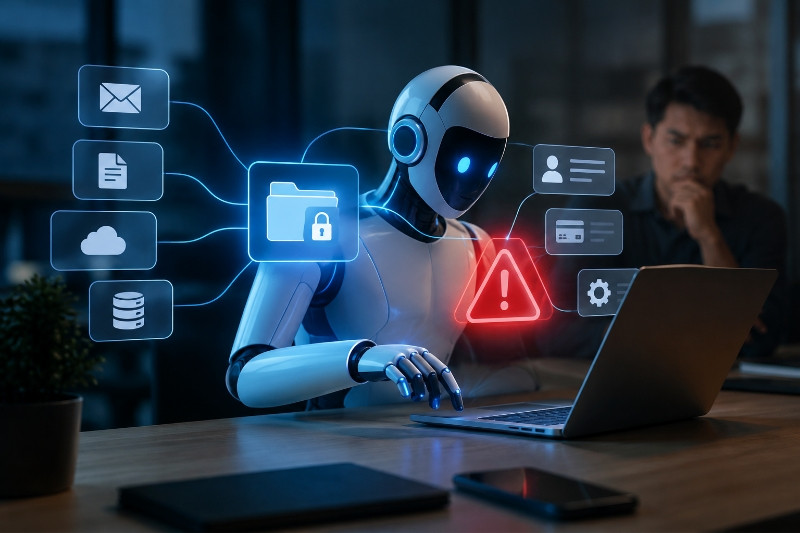
TECHNOLOGY, JEJAKNARASI.ID – Artificial intelligence is entering a new phase in which digital assistants are no longer limited to answering questions or generating text. AI agents are increasingly designed to perform tasks, interact with software, process information, and execute multi-step workflows with varying degrees of human supervision.
The shift promises faster operations and lower administrative workloads. However, it also raises a difficult question for businesses: how much authority should an AI system have over the tools and information it uses?
For companies adopting AI, the challenge is no longer simply choosing a capable model. It is determining what that model can access, which actions it can perform, and who remains accountable when something goes wrong.
ADVERTISEMENT

SCROLL TO RESUME CONTENT
From Answering Questions to Taking Action
Traditional AI assistants generally respond to user instructions. AI agents can go further by carrying out a sequence of actions toward a defined objective.
Depending on their configuration, these systems may retrieve information from company databases, organize documents, prepare reports, interact with business applications, or initiate routine workflows.
Such capabilities could benefit small businesses that lack large administrative or technical teams. Tasks that previously required employees to move information between several applications may eventually be handled through automated processes.
Yet greater autonomy introduces a different category of risk.
An AI system that produces an inaccurate answer may mislead a user. An AI agent with permission to modify records, send messages, or access confidential files could potentially turn a similar mistake into an operational incident.
The consequences depend on the system’s permissions, safeguards, and level of human oversight.
Why Access Control Matters
One of the most important security questions surrounding AI agents concerns permissions.
Employees are usually assigned different levels of access depending on their responsibilities. An accounting employee, for example, may need financial records but not unrestricted access to customer databases or internal security systems.
AI agents require similar boundaries.
If a company connects an agent to multiple applications without carefully limiting its permissions, the system may gain access to more information than necessary. A compromised account, a misleading instruction, or an unexpected interaction with external content could then create additional exposure.
Security researchers have increasingly examined threats involving indirect prompt injection, in which malicious instructions embedded in content processed by an AI system attempt to influence its behavior.
The presence of such content does not automatically mean an attack will succeed. The actual risk depends on the model, its surrounding software, available permissions, and the controls implemented by the organization.
Nevertheless, the principle is straightforward: an AI agent should not receive unrestricted authority merely because it is capable of performing a task.
The Problem of Invisible Automation
Another challenge emerges when organizations introduce AI tools faster than they establish internal rules.
Employees may experiment with third-party assistants, connect applications, or build automated workflows without fully understanding where information is processed or how long it is retained.
As these tools become embedded in everyday operations, managers may struggle to identify which systems have access to sensitive information and which automated actions are taking place.
Research published by the Organisation for Economic Co-operation and Development in April 2026 identified cybersecurity, skills gaps, maintenance costs, and limited time as continuing challenges for small and medium-sized enterprises adopting AI.
The findings highlight an important distinction between having access to AI and being prepared to use it responsibly.
For smaller companies, formal security teams may not always be available. Clear internal policies, careful vendor selection, and basic access controls therefore become especially important.
Four Safeguards Businesses Should Consider
Organizations do not necessarily need to abandon AI automation to reduce these risks. They can begin by establishing practical safeguards before granting agents greater independence.
1. Apply the principle of least privilege
An AI agent should receive only the permissions necessary to complete its assigned task. Access to confidential files, financial transactions, customer records, and administrative controls should be restricted according to actual business needs.
2. Require approval for high-impact actions
Actions such as transferring money, deleting important records, changing access permissions, or sending sensitive information externally should require appropriate human authorization.
The level of supervision should reflect the potential consequences of an error.
3. Monitor activity and maintain audit logs
Businesses should be able to review what an agent accessed, which actions it attempted, and whether those actions were completed. Monitoring can help organizations identify unusual behavior and investigate incidents more effectively.
4. Test systems before expanding their authority
AI agents should be evaluated in controlled environments before being connected to critical business operations. Testing should examine how they respond to conflicting instructions, untrusted documents, unexpected inputs, and failed tasks.
Companies should also establish procedures for disabling an agent and revoking its access when suspicious activity occurs.
A New Responsibility for Technology Providers
Responsibility does not rest solely with the organizations deploying AI.
Technology providers also have a role in making permissions understandable, documenting system limitations, protecting customer information, and providing reliable mechanisms for monitoring and controlling automated actions.
Businesses should ask vendors how their products handle sensitive data, whether customer information is used to improve models, what access controls are available, and how security incidents are reported.
Clear answers can help organizations evaluate whether an AI product is suitable for a particular task.
Regulators and industry standards bodies also face the challenge of addressing increasingly autonomous systems without unnecessarily restricting beneficial innovation.
The central issue is not whether AI agents should be used, but how their capabilities can be matched with appropriate safeguards and accountability.
Trust Will Determine the Future of AI Automation
AI agents could become valuable tools for businesses seeking to reduce repetitive work and improve operational efficiency. Their long-term usefulness, however, will depend on more than speed or technical performance.
Organizations need to understand the boundaries of automated decision-making, protect information from unnecessary exposure, and preserve meaningful human oversight where the consequences of failure are significant.
The most effective AI strategy may therefore be one that expands automation gradually rather than granting maximum independence from the beginning.
As digital assistants gain the ability to act rather than simply respond, security must become part of their design from the outset.
The future of AI automation will not be determined solely by what these systems can do. It will also depend on whether businesses can control what they are allowed to do.